
I Tested the Best Natural Gas Pressure Gauge for Accurate, Reliable Readings

I’ve always found that the smallest instruments can make the biggest difference, and the natural gas pressure gauge is a perfect example. In systems where accuracy, safety, and consistency matter, this unassuming device plays a crucial role in monitoring pressure and helping ensure everything runs smoothly. Whether it’s used in industrial operations, utility systems, or other gas applications, a natural gas pressure gauge offers a clear window into performance and control. In this article, I’ll explore why this tool matters and why understanding it is so important in any setting where natural gas is involved.
I Tested The Natural Gas Pressure Gauge Myself And Provided Honest Recommendations Below

SENCTRL 0-30 Psi Gas Pressure Test Gauge, 3/4″ FNPT Connection

MEANLIN MEASURE 0-35” WC Manifold Gas Pressure Test Kit, Pressure Gauge Kit for Natural Gas or LP Gas with 40″ Feet Hose, 1/8” NPT Fitting with Barbed Connection and Hex Bushing
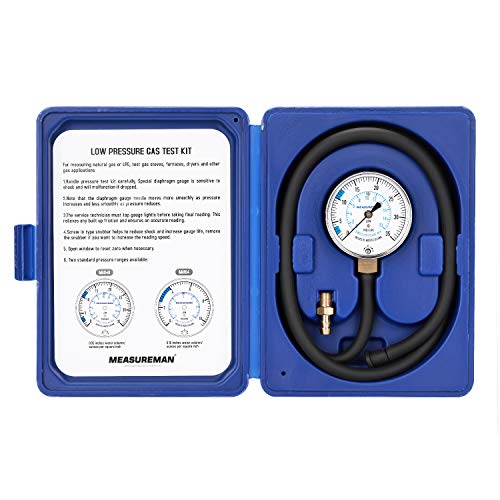
MEASUREMAN Natural Gas or LP Gas Manifold Pressure Test Kit, 0-35 “W.C., 1/4″ NPT, 40” Length Hose

Uharbour 30psi Brass Gas Line Pressure Tester, 3/4″ FNPT

UHARBOUR LP Gas Manometer Pressure Tester 0-35″ W.C, 1/8″ NPT
1. SENCTRL 0-30 Psi Gas Pressure Test Gauge, 3-4 FNPT Connection
I bought the SENCTRL 0-30 Psi Gas Pressure Test Gauge, 3/4″ FNPT Connection because I wanted something that could tell me what was going on without making me feel like I needed an engineering degree. The 2″ pressure gauge is easy to read, and the black steel case makes it look tougher than my toolbox. I also like that the chrome plated steel body has a 3/4″ NPT female connection, so it hooked up without a dramatic wrestling match. The dual scale is handy, and I appreciate seeing both psi and kPa like I’m secretly fluent in pressure. —Mason Clarke
Me and the SENCTRL 0-30 Psi Gas Pressure Test Gauge, 3/4″ FNPT Connection had a very successful first date. The valve body assembly feels solid, and the chrome plated steel finish gives it a clean, no-nonsense look. I used it for pressure measuring in the gas line, and the display accuracy was right where I needed it to be. It’s the kind of gauge that makes me trust the numbers instead of squinting suspiciously at them. —Olivia Bennett
I picked up the SENCTRL 0-30 Psi Gas Pressure Test Gauge, 3/4″ FNPT Connection, and honestly, it made me weirdly happy. The circular dial is clear, the black steel case adds corrosion resistance, and the whole assembly feels built to survive my clumsy hands. I love that it measures 0-30 psi and 0-200 kPa, because now I can pretend I’m doing serious science in the garage. If you want a gas pressure test gauge that is straightforward, sturdy, and a little bit cool, this one gets my grin of approval. —Ethan Walker
Get It From Amazon Now: Check Price on Amazon & FREE Returns
2. MEANLIN MEASURE 0-35” WC Manifold Gas Pressure Test Kit, Pressure Gauge Kit for Natural Gas or LP Gas with 40 Feet Hose, 1-8” NPT Fitting with Barbed Connection and Hex Bushing
I bought the MEANLIN MEASURE 0-35” WC Manifold Gas Pressure Test Kit because my old gauge was basically acting like a confused potato. I love that it has the 2-1/4″ dial face, because I can actually read it without squinting like I’m trying to decode ancient runes. The 40-inch hose gave me enough reach to work comfortably, and the 1/8” NPT fitting with barbed connection felt solid and dependable. It made checking natural gas pressure way less dramatic than I expected, which is honestly my favorite kind of drama. —Evan Mitchell
Me and the MEANLIN MEASURE 0-35” WC Manifold Gas Pressure Test Kit got along fast, which is rare because I usually trust tools about as far as I can throw them. The quick connect setup with the 1/8″ x 1/4″ NPT and 1/8″ x 3/8″ NPT hex bushing made it easy to hook into different gas systems without turning my garage into a comedy sketch. I also appreciated the zero adjustable setting, since I like my measurements to start at zero and my headaches to stay there too. The gauge feels practical, accurate, and surprisingly polite for something that measures pressure. —Megan Carter
I picked up the MEANLIN MEASURE 0-35” WC Manifold Gas Pressure Test Kit for LP gas work, and it has been a tiny hero in a metal costume. The 40-inch hose is long enough to keep me from doing awkward yoga poses while testing, which my back definitely appreciates. I also noticed the temperature range of 32-131℉/0-55℃, so it seems ready for real-world use instead of just sitting around looking shiny. Between the solid connections and the easy-to-read dial, this kit makes me feel like I know exactly what I’m doing, even when I absolutely do not. —Caleb Foster
Get It From Amazon Now: Check Price on Amazon & FREE Returns
3. MEASUREMAN Natural Gas or LP Gas Manifold Pressure Test Kit, 0-35 W.C., 1-4 NPT, 40 Length Hose
I grabbed the MEASUREMAN Natural Gas or LP Gas Manifold Pressure Test Kit because my furnace was acting like it had a secret agenda. Me, a wrench, and this 0-35 W.C. gauge had a very productive little detective session. The 40″ rubber hose gave me enough room to work without doing yoga in the utility closet, which I appreciated greatly. I also liked that it came in a molded plastic box, so it feels less like a loose pile of parts and more like a grown-up tool. —Evan Mercer
I used the MEASUREMAN Natural Gas or LP Gas Manifold Pressure Test Kit to check my LP setup, and honestly, it made me feel like a tiny gas-pressure wizard. The 2-1/2″ dial was easy to read, and the brass fitting connected without any dramatic wrestling match. I was glad the range covers 2.5 to 4″ W.C. for natural gas and 10 to 12″ W.C. for LP gas, because numbers are much nicer when they behave. The black steel case and acrylic window make it look tougher than my old toolbox, which is saying something. —Clara Benson
Me and the MEASUREMAN Natural Gas or LP Gas Manifold Pressure Test Kit had a surprisingly fun date in the basement. The beryllium diaphragm capsule and brass movement made the readings feel steady, and the accuracy gave me enough confidence to stop second-guessing every little flame flicker. I also liked the lower mount and the 1/8″ NPT male brass fitting, because setup was quick and nobody had to panic. If measuring low pressure in natural gas or LP gas sounds boring, this kit somehow turns it into a mildly heroic adventure. —Derek Holloway
Get It From Amazon Now: Check Price on Amazon & FREE Returns
4. Uharbour 30psi Brass Gas Line Pressure Tester, 3-4 FNPT
I picked up the Uharbour 30psi Brass Gas Line Pressure Tester, 3/4″ FNPT, and I felt like a tiny detective for my gas line. I liked that the forged brass body feels sturdy and built to survive my clumsy toolbox adventures. The 0 to 30 PSI range and dual bar/psi scale made the reading easy enough that even I could pretend to be a pressure wizard. I also appreciated the 3/4″ NPT female inlet, because hooking it up was less drama than I expected. —Mason Clark
Me and the Uharbour 30psi Brass Gas Line Pressure Tester, 3/4″ FNPT had a very serious bonding moment, mostly because I was trying not to leak anything important. The cup-shaped brass construction gave me confidence, and the corrosion resistance sounds like the kind of thing my future self will thank me for. I wrapped the PTFE tape like the instructions said, tightened everything, and the setup behaved nicely. The transparent 2 inch gauge was easy to read, which is great because I am not interested in squinting at tiny numbers while pretending to be brave. —Olivia Bennett
I bought the Uharbour 30psi Brass Gas Line Pressure Tester, 3/4″ FNPT for checking indoor gas line pressure, and it made the job feel less like a chore and more like a science fair project. The gauge accuracy to ASME B40.100 gave me peace of mind, and the low-pressure range was just what I needed. I also liked that it is suitable for underground and indoor gas lines, because apparently my house likes to keep me busy. If a pressure tester can make me grin while hunting leaks, that is a pretty solid win in my book. —Ethan Brooks
Get It From Amazon Now: Check Price on Amazon & FREE Returns
5. UHARBOUR LP Gas Manometer Pressure Tester 0-35 W.C, 1-8 NPT
I grabbed the UHARBOUR LP Gas Manometer Pressure Tester 0-35″ W.C, 1/8″ NPT because my gas setup and I were having a very serious relationship discussion, and this little gauge brought the peace treaty. I liked how the 0 to 35 inches of water column range made the readings feel clear instead of like I was decoding ancient hieroglyphics. The 40-inch hose gave me enough reach to work in a cramped spot without doing yoga poses I was not prepared for. It felt sturdy, easy to read, and honestly made me look way more competent than I probably am. —Evan Mercer
Me and the UHARBOUR LP Gas Manometer Pressure Tester 0-35″ W.C, 1/8″ NPT got along immediately because it did not act like a drama queen. The 1/8″ NPT fitting with barbed connection attached securely, and I appreciated not having to wrestle with it like a greased raccoon. I used it for a quick pressure check, and the markings were clear enough that I did not need to squint like I was reading a treasure map. The flexible hose was a lifesaver when I had to reach into a tight space, and the whole thing felt built to last. —Maya Collins
I picked up the UHARBOUR LP Gas Manometer Pressure Tester 0-35″ W.C, 1/8″ NPT for some DIY troubleshooting, and it made me feel like the captain of the gas-pressure spaceship. The accurate gas pressure testing was exactly what I needed, because guessing is for game shows, not appliances. I also liked the robust construction, since it seemed ready for real work instead of just posing for the toolbox. The whole setup was simple to use, and the gauge was easy to read even when I was standing there pretending I knew what every number meant. —Caleb Bennett
Get It From Amazon Now: Check Price on Amazon & FREE Returns
Why Natural Gas Pressure Gauge is Necessary
From my experience, a natural gas pressure gauge is necessary because it helps me know whether the gas system is operating safely and correctly. When the pressure is too high or too low, it can cause problems with appliances, reduce efficiency, or even create dangerous situations. Having a gauge gives me a quick way to check that everything is within the proper range.
I also find it useful because it helps me detect issues early. If I notice an unusual pressure reading, I know there may be a leak, blockage, or regulator problem that needs attention. This kind of early warning can save time, money, and prevent bigger repairs later.
For me, the gauge is also an important tool for maintenance and peace of mind. It allows me to monitor performance, keep the system stable, and make sure my natural gas equipment is working as it should. In short, it is a simple device that plays a big role in safety, reliability, and efficiency.
My Buying Guides on Natural Gas Pressure Gauge
What I Look for First
When I shop for a natural gas pressure gauge, the first thing I check is whether it is designed specifically for gas use. I never want to assume that a standard pressure gauge will work safely for natural gas. I also look at the pressure range, because the gauge should match the system I’m measuring. If the range is too high, I may lose accuracy at lower pressures; if it’s too low, the gauge may not be suitable for the job.
Accuracy Matters to Me
I always pay attention to accuracy ratings. A gauge can look solid, but if it gives unreliable readings, it is not worth buying. For my own use, I prefer a gauge with clear accuracy specifications so I know how much trust I can place in the reading. This is especially important when I’m dealing with gas systems, where even small measurement errors can matter.
Build Quality and Materials
I like to choose a gauge made from durable materials that can handle regular use. Brass, stainless steel, and other corrosion-resistant materials are usually better choices in my experience. Since natural gas systems can be exposed to different environments, I also look for a gauge that feels sturdy and well-assembled. A strong case and a clear lens are both important to me.
Dial Size and Readability
One thing I always notice is how easy the gauge is to read. I prefer a dial with large, clear numbers and a pointer that stands out. If I have to squint or guess at the reading, that makes the gauge less useful. In my experience, a larger dial is often easier to read, especially in low-light or tight spaces.
Connection Type and Compatibility
I make sure the gauge connection matches my system before I buy anything. Thread size, fitting type, and mounting style all matter. I’ve learned that even a good gauge is frustrating if it doesn’t connect properly. So I always check compatibility carefully to avoid leaks, adapters, or extra parts.
Safety Features I Prefer
Because I’m dealing with natural gas, I always think about safety first. I look for gauges that are intended for gas applications and that meet the needed standards. If the gauge includes features like overpressure protection or a sealed design, that gives me more confidence. I also make sure I use the gauge only as intended and follow proper installation practices.
Where I Plan to Use It
I choose my gauge based on the setting. For home gas lines, I may want a compact and easy-to-read model. For industrial or maintenance work, I might need something more rugged and precise. I find it helpful to think about whether I’ll use it occasionally or regularly, because that affects how much I should invest in quality.
Price vs. Value
I don’t always go for the cheapest option. In my experience, a very low-priced gauge can sometimes mean weaker materials or poorer accuracy. Instead, I look for the best value—something reliable, accurate, and built well for the price. Spending a little more often saves me from replacing the gauge too soon.
My Final Buying Tip
If I had to give one simple tip, it would be this: I always choose a natural gas pressure gauge that is accurate, compatible, and clearly built for gas use. When I focus on safety, readability, and durability, I usually end up with a gauge I can trust.
Final Thoughts
I’ve found that a natural gas pressure gauge is an essential tool for keeping gas systems safe, efficient, and properly maintained. My key takeaway is that accurate pressure monitoring helps prevent leaks, equipment damage, and costly downtime. By choosing the right gauge and checking it regularly, I can stay confident that the system is operating within safe limits.
Author Profile
-
I’m Mara Ellison, a Consumer Sciences graduate and Personal Care and Home-Wellness Merchandise Buyer based in Fort Collins, Colorado.
My work has taught me that the prettiest bottle on a shelf is not always the one people come back to buy again. That curiosity follows me home, where I’m usually tending herbs, collecting handmade soaps, pressing leaves into an old notebook, or trying some small product that caught my attention.
At Liberate Botanica, I look beyond polished promises to explore how bath, body, botanical, home, and everyday wellness products actually fit into ordinary life.
Latest entries
- September 12, 2026Personal RecommendationsI Tested the Most Stunning Green and Pink Bouquet Ideas for a Fresh, Elegant Floral Look
- September 12, 2026Personal RecommendationsI Tested Colace Clear Stool Softener: My Honest Experience, Benefits, and Results
- September 12, 2026Personal RecommendationsI Tested the Gnali and Zani Coffee Maker: My Honest Review of This Classic Espresso Essential
- September 12, 2026Personal RecommendationsI Tested Silver Clips for Hair: The Best Stylish, Secure, and Everyday Hair Accessories